RhythmQ Inc.
Modernizing Legacy Platform
I led the redesign of RhythmQ’s legacy platform to eliminate extreme form fatigue. By introducing a centralized "General Application" and a multi-brand atomic design system, we drastically reduced application times and automated administrative workflows.
Role
Product Design Lead
Year
2026
Focus
Status
Shipped

Problem
The Friction Points
Submitters
Applicants spent 15+ minutes per application, repeatedly typing identical personal and academic details across dozens of scholarships. Result: High drop-off rates.
Admins
Admins lacked modular tools. They had to manually recreate new forms from scratch for every scholarship category, even when 80% of the questions were identical.
Reviewers
Without automated filtering, reviewers wasted countless hours manually evaluating submissions from applicants who didn't meet basic eligibility criteria.
DESIGN PROCESS
Agile Design Process

SOLUTION
1-Click Apply for Applicants
Applicants answer common questions once. If a scholarship requires no extra information, they apply instantly with one click. If it requires more details, a short popup asks only the missing questions.


Modular Setup for Admins
Admins create the main application form once. When adding a new scholarship, they only type in the unique questions for that specific category instead of building a whole new form.


Automated Filtering for Reviewers
The system checks the applicant's initial answers and hides scholarships they do not qualify for. This ensures reviewers only receive and read eligible applications.
Design System
Multi-Brand Atomic Design System
I built a scalable component library utilizing atomic design principles structuring elements from base atoms up to complex organisms. By establishing a rigid foundation of primitive and semantic tokens, paired with multi-mode Figma variables and nested instances, the system allows for instant, automated white-label skinning for new clients. Accessibility was baked into the core properties of every component. To ensure a seamless engineering handoff, I integrated strict usage guidelines and technical annotations directly alongside the UI.

Accessibility
Accessible Components
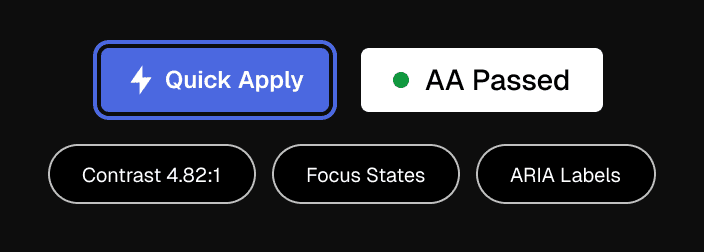
I tested all text contrast, button sizes, and form inputs to ensure the platform is fully accessible to all users and meets strict WCAG guidelines by default.
The Results
75%
Less time spent by applicants.
80%
Faster form setup for admins.
100%
Qualified applications for reviewers.
Takeaways
Fix the Root Problem
Improving the applicant experience meant we had to fix how admins created forms first.
Centralize Data
Asking for shared information once stops users from abandoning forms.
Tokens Save Time
Setting up design tokens early made it much faster to launch new client themes.


